AI Won’t Compress Your Implementation Timeline (And You Shouldn’t Want It To)
By Al Cormier, Director of Thought Leadership and Corporate Partnerships, Mi-Case
If you haven’t heard the AI implementation pitch yet, you will.
Shorter timelines. Faster migration. Go-live in months, not years. Some of that is even true. Data migration? Faster. Configuration? Faster.
But in thirty years of corrections, I’ve never seen an implementation fail because one piece of the technology was moving too slow. The hardest parts are human. They always have been. AI doesn’t change that. Not even a little.
I know this because I lived it.
Early in my time as Chief of Operations, I helped push a go-live forward by three months. Not because the system was ready. Not because the staff were ready. Because a budget deadline needed the old system off the books before fiscal year end.
What happened next was predictable to everyone except the people who made the call. Workarounds within the first week. Data entry errors that took months to untangle. Staff who mentally checked out of the new system and went back to paper. The technology worked fine. The implementation failed because the timeline didn’t leave room for the people who had to use it.
The Hard Parts Are Human
I’ve been writing recently about the five barriers to AI adoption in corrections: workforce trust, data quality, governance gaps, procurement constraints, and regulatory uncertainty. Every one of them is a people problem, not a technical one. And every one of them is a reason to protect your timeline, not compress it.
AI can help with pieces of the technical work. It can flag data anomalies, identify duplicates, speed up parts of configuration. That’s genuinely useful. But it doesn’t train your staff. It doesn’t build trust with a workforce that’s running on fumes from mandatory overtime. It doesn’t write your governance framework. And it doesn’t navigate your procurement cycle.
When I was running operations, we routinely didn’t have specific policy for half of what the technology was doing. We wrote policy after deployment, and that’s the wrong order. You can’t automate a process that hasn’t been defined yet. Compressing the timeline doesn’t fix that problem. It guarantees it.
Three Things Worth Protecting
I’m not arguing for slow. I’m arguing for honest. A responsible implementation accounts for what “implementation” actually means. For most agencies, that’s twelve to twenty-four months depending on scope and starting point. The number matters less than whether the timeline was set based on the agency’s actual readiness or on what sounded good during a budget hearing.
If I were advising an agency under pressure to accelerate, I’d tell them to protect three things:
1. Hands-on staff involvement in configuration and testing.
Not a checkbox. Not a demo they sit through. I mean the people who will use this system every day shaping how it works in their facility. When staff feel ownership over the configuration, they defend it after go-live instead of working around it.
2. Data migration validated by operational staff, not just IT.
The people who use the data daily are the ones who know when something doesn’t look right. An IT sign-off tells you the data transferred. An operational sign-off tells you it’s accurate.
3. Post-go-live support measured in months, not weeks.
This is the phase that gets cut first when budgets tighten, and it’s the most expensive thing to cut. Not because of the line item. Because that’s when you lose your staff. Not physically. Mentally. They find workarounds instead of working through the system, and two years later leadership is wondering why adoption is low and the data looks the same as it did before.
The Real Stakes
AI will improve corrections technology. It already is. But the agencies that succeed with AI-enabled systems will be the ones that resist the pressure to compress the human side of implementation.
At Mi-Case, we don’t put a go-live date in a contract until we know the answers to the questions that actually determine success: Is the staff ready? Is the data clean? Are the policies written? That’s not caution. That’s twenty-five years of learning what happens when you skip those steps.
The agencies that go live on time aren’t luckier. They just asked these questions before the contract was signed.
Where Does Your Agency Stand?
Al's three questions aren't rhetorical. They're the starting point of a real evaluation.
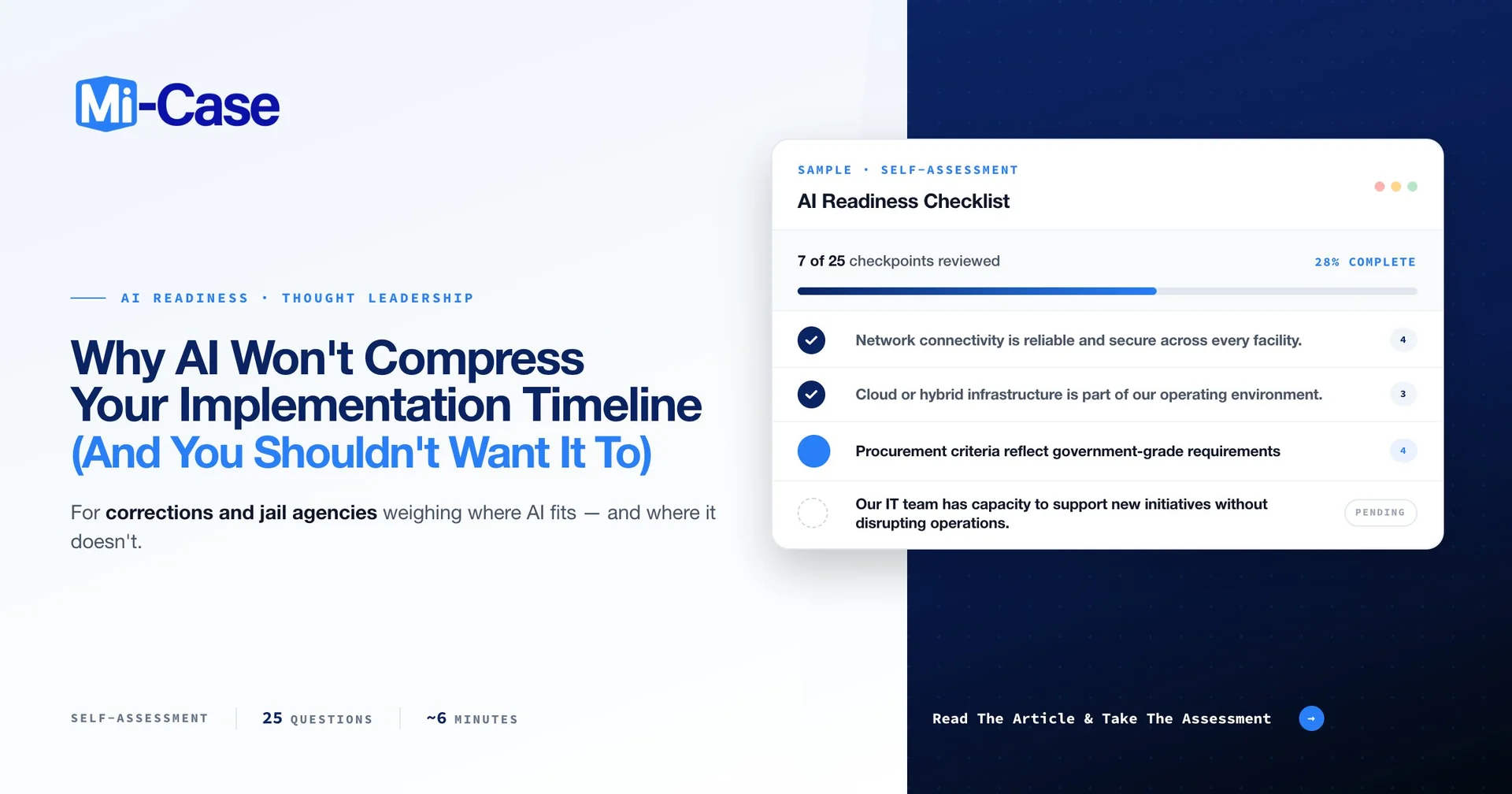
Mi-Case's AI Readiness Self-Assessment scores your agency across five areas that determine whether an implementation succeeds or stalls: data readiness, technology infrastructure, governance and policy, workforce and culture, and strategic alignment.
Twenty-five questions. Five minutes. A clear picture of where you stand before the vendor conversation starts.

Al Cormier is Director of Thought Leadership and Corporate Partnerships at Mi-Case and a 30-year corrections professional. His career spans roles from correctional officer through Chief of Operations, including service as a National Institute of Corrections instructor and state-certified security auditor.
.png)